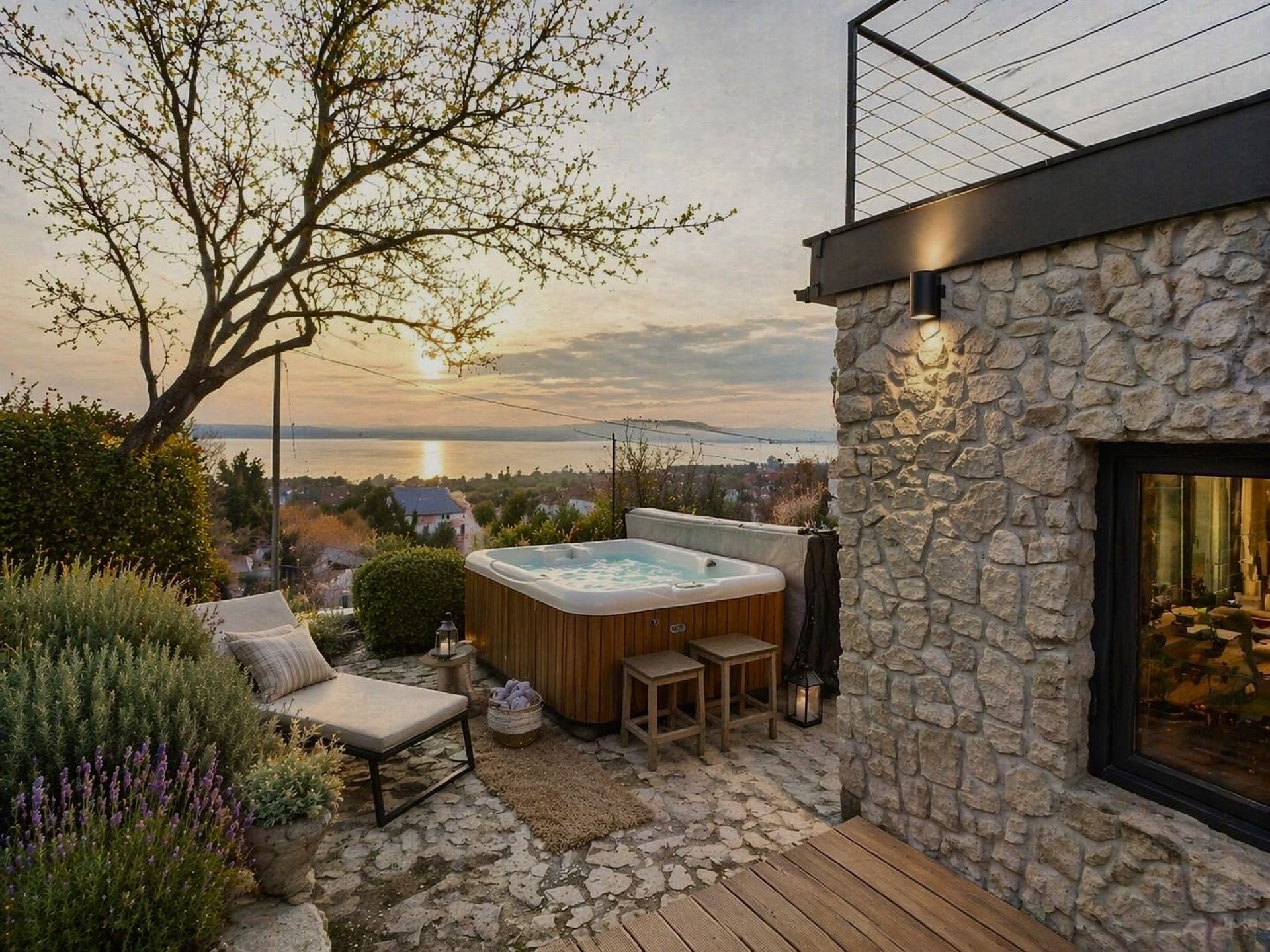
The question investors have asked us most often this past year: "Balaton or Budapest?" The answer is rarely straightforward — and almost never reduces to "higher yield." These are two fundamentally different markets, and which one is better depends entirely on your own priorities. Are you looking for steady monthly cash flow, or long-term capital appreciation combined with a stable second home?
The character of each market
Budapest offers steady demand year-round. Inner-district occupancy runs 65–75% on an annual basis in 2026. Seasonality exists but is modest — festive December weekends and the May-to-September stretch are somewhat higher, but for 70% of weeks "someone is always in the property." Cash flow is predictable, and operational logistics are simpler: one cleaning team, one handyman, and everything fits within a 15-minute urban radius.
Lake Balaton is strongly seasonal. Around 70% of annual revenue comes from four months — June through September — with roughly half of that concentrated in July and August alone. Peak ADR can reach HUF 80,000–120,000 on a premium villa. October through April, however, monthly revenue can fall to as little as a quarter of peak. The return logic isn't monthly — it's annual.
The numbers
| Metric (2025 actual) | Budapest (Districts V–VII) | Lake Balaton (premium, north shore) |
|---|---|---|
| Typical purchase price | 130–180 M HUF (60–80 m²) | 130–300 M HUF (100–180 m²) |
| Annual ADR (avg.) | 32,000 HUF | 58,000 HUF |
| Annual occupancy | 72% | 39% |
| Annual net yield | 6,100,000 HUF | 7,400,000 HUF |
| Net yield ratio | 4.4% | 3.8% |
| Operational complexity | low | medium–high |
| Capital appreciation (5 yrs) | ~28% | ~42% |
Source: ST Management portfolio and benchmark 2024–2025, Hungarian National Bank housing price index, AirDNA data. Yield ratio on gross purchase price, after operating cost, cleaning, IFA, and flat-rate personal income taxation.
"Balaton isn't a cash-flow business — it's wealth building. Owners who don't recognise that typically disillusion themselves by mid-winter."
Which one fits you?
Budapest fits if…
- you want supplementary monthly income with predictable cash flow
- you live in another city or abroad, and visit the property rarely
- this is a first property investment where liquidity matters (ease of exit)
- you don't want to worry about a mid-winter boiler failure or solar system repair
Lake Balaton fits if…
- you're thinking long-term capital appreciation, and personal use also matters (family holidays)
- you can absorb an additional HUF 1–1.5 M annual operating buffer for off-season
- you're comfortable working with a good operational partner (remote management is genuinely difficult)
- you like the dual model: intense summer revenue, winter personal use or longer-term lets
The hybrid model
Increasingly common in our portfolio is the combined approach: a Budapest inner-city apartment as a cash-flow engine, paired with a Lake Balaton property as an appreciation and personal-use asset. The risk and seasonality profiles of the two markets are effectively opposite — which is precisely what makes the portfolio diversified.
If you're exploring options now, three considerations are worth working through in a free consultation:
- Financial objective — monthly income or long-term wealth?
- Lifestyle — do you plan to use the property yourself occasionally?
- Risk tolerance — could you absorb a 30% revenue drop after a poor season (Balaton), or is monthly stability more important (Budapest)?
The short conclusion
In three sentences: Budapest is more stable, simpler to operate, and generates monthly cash — making it far safer as a first serious investment. Lake Balaton offers higher peak ADR and more personal enjoyment, but only four months of intense revenue — better suited to a second or third property. The hybrid model is the most effective, but only really makes sense once total capital crosses the HUF 300 M mark.
If you'd like to break the numbers down to your specific situation — target price range, financing, expected yield, operational model — we'd be glad to sit down with you.